
Implant alone
The cylinders are placed inside the erection chambers and inflated. For milder curves, the rigid cylinders alone may straighten the penis enough.
Peyronie's disease surgery
When Peyronie's disease comes with erectile dysfunction, a penile implant can restore firm erections and straighten the penis in the same operation. Here is how the combined surgery works and what recovery involves.
Who it is for
Many men with Peyronie's disease also have erectile dysfunction. Sometimes the scar tissue itself affects how the erection chambers work; sometimes the two conditions simply occur together, for example with age, diabetes or after prostate treatment.
If erections are no longer firm enough, straightening the penis on its own will not restore sex life, and grafting may even make erections weaker. A penile implant addresses both problems: it provides rigidity on demand, and the curve is corrected while the implant is placed.
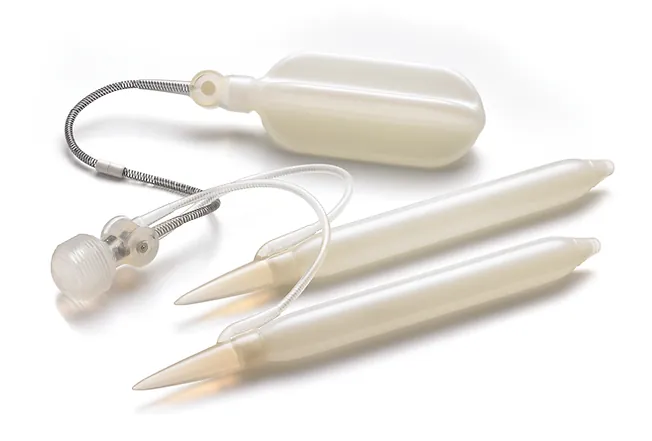
A three-piece inflatable implant: two cylinders, a pump and a reservoir, all placed inside the body.
Straightening
The implant itself often reduces the curve. What remains is corrected in theatre, step by step, using the least invasive method that works for you.
The cylinders are placed inside the erection chambers and inflated. For milder curves, the rigid cylinders alone may straighten the penis enough.
With the implant fully inflated, the surgeon gently bends the penis in the direction opposite to the curve and holds it for a short time, stretching the plaque. This can be repeated.
If a significant curve remains after modelling, the plaque can be released with a small incision, sometimes covered with a graft, or plication stitches can be added.
Devices
Most men with Peyronie's disease receive a three-piece inflatable implant, because it gives firm rigidity when inflated and a soft penis when deflated. The Peyronie's disease and prosthesis package includes the Coloplast Titan Touch. Other inflatable devices, such as the Boston Scientific AMS 700 family, can also be used, and a malleable implant may suit some men.
The choice depends on your anatomy, your length, the severity of the deformity and your hand dexterity, and is made with you after examination. No single device suits everyone.
Infection prevention
Infection is the complication patients worry about most, because an infected implant usually has to be removed. Every implant operation follows the non-touch protocol: the device is kept away from the skin and from the surgeon's gloves throughout, and antibiotic-coated devices and intravenous antibiotics are used.
Before surgery
After surgery
| When | What usually happens |
|---|---|
| Days 1–2 | Catheter and drain removed; up to two nights in hospital. |
| Week 1 | Swelling and discomfort settle. Keep the wound clean and dry; your surgeon will tell you when you can shower. |
| Days 7–10 | Wound check. You are shown how to use the pump when healing allows. |
| Weeks 2–6 | Regular inflation may be advised to help keep length and straightness. |
| Week 6+ | Intercourse usually resumes once your surgeon confirms healing. |
Risks you should know about. Implant surgery with straightening carries the risks of any operation, including bleeding, haematoma and infection; an infected implant usually has to be removed. Specific risks include a small residual curve, mechanical failure of the device over time, erosion, altered sensation and, where modelling or grafting is needed, a slightly higher chance of complications. The implant does not restore length already lost to Peyronie's disease. Placing an implant is an irreversible change: if it is later removed, other treatments for erectile dysfunction are unlikely to work. Results vary, and your surgeon will discuss your individual risks before you decide.
Package
The combined operation is offered as an all-inclusive package. You receive a personalised quote after your free consultation.
Send us your history and photographs, or book a video consultation with the team of Prof. Dr. Ateş Kadıoğlu.
Personalised quote after your free consultation
The aim is a penis straight enough for comfortable intercourse. A small residual curve can remain and usually does not cause problems. Results vary with the severity of the original deformity.
An implant does not usually restore length already lost to Peyronie's disease. Careful sizing, modelling and regular inflation after surgery help make the most of the length you have.
It can take a little longer, and extra steps such as modelling or grafting add some risk. Your surgeon will explain how this applies to you.
Photographs of the erect penis and your medical history allow an initial assessment before you travel. The final plan is confirmed after examination in Istanbul.
Keep reading
Free, confidential, no obligation
Send us your question or medical reports. A member of our English-speaking team will reply, and where appropriate your case is reviewed by the surgeon before we suggest a plan.