
Often considered if you have
- Stable disease, usually for at least three months
- A severe curve, often over about 60°, or a complex curve
- An hourglass narrowing or hinge effect
- Good, reliable erections before surgery
- Concern about losing more length
Peyronie's disease surgery
For larger or more complex curves, the plaque can be cut or partly removed and the gap covered with a graft. This lengthens the short side of the penis rather than shortening the long side, so it aims to limit further loss of length.
What it is
In Peyronie's disease, a plaque of scar tissue holds one side of the penis back during an erection. Plication straightens the penis by shortening the opposite side. Grafting works the other way round: it releases the short side.
The surgeon either makes a cut in the plaque (incision) or removes part of it (partial excision). When the penis is straightened, this opens a gap in the sheath around the erection chamber. The gap is covered with a patch of graft material, which the body gradually incorporates as it heals.
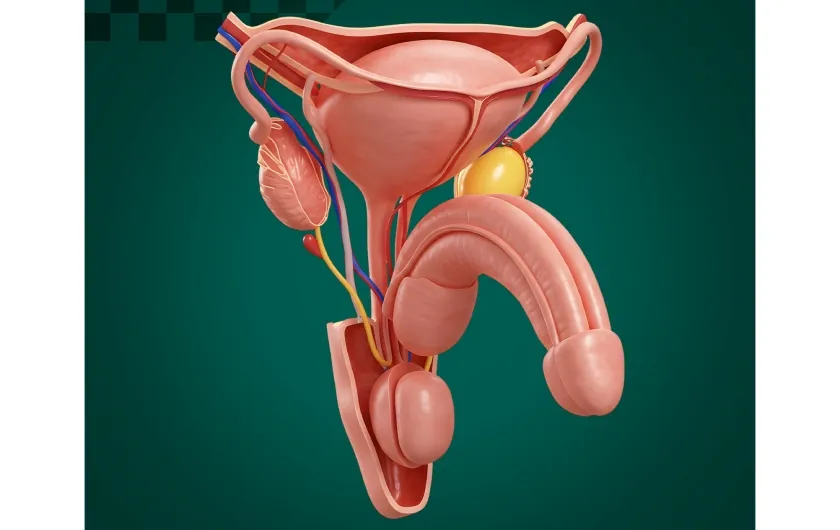
The graft is placed in the sheath around the erection chambers, where the plaque was released.
Who it suits
Grafting is a more complex operation than plication and is chosen carefully. It is one of several options on the Peyronie's disease treatment ladder.
The operation
The operation takes place in hospital, usually under general anaesthesia. Before surgery, erection quality is assessed carefully, often with Doppler ultrasound, because good erections are essential for a good result.
Several types of graft material exist, including processed biological tissues such as pericardium or collagen-based patches. Your surgeon will explain which material is planned for you and why.
The skin is opened, usually around the head of the penis, and the nerves and blood vessels on the upper side of the penis are carefully lifted away from the plaque.
An erection is produced with saline to show the exact point of maximum curvature.
The plaque is cut, or part of it removed, so the penis can straighten. This leaves a defect in the sheath.
The graft is stitched into place. Small plication stitches may be added to fine-tune the result, and a final erection confirms the penis is straight.
Before surgery
After surgery
| When | What usually happens |
|---|---|
| Days 1–2 | Compression dressing; one or two nights in hospital. |
| Week 1 | Swelling and bruising, which settle gradually. Most men can return to desk work within a few days. |
| Days 7–10 | Wound check, in Istanbul or online. |
| Weeks 2–6 | Your surgeon may recommend gentle stretching or a traction device to help the graft heal without shrinking. |
| Week 6+ | Intercourse and strenuous exercise usually resume once your surgeon confirms healing. |
Contact us promptly if you notice severe swelling, increasing pain, bleeding or discharge from the wound.
Risks you should know about. Grafting carries the general risks of surgery, including bleeding, haematoma and infection. The most important specific risk is new or worsened erectile dysfunction, which some men develop after grafting and which may need treatment with tablets or, in some cases, a penile implant later. Other risks include reduced or altered sensation of the penis, a curve that is not fully corrected or returns, graft contraction with some loss of length, and a feeling of bulging or unevenness at the graft site. Results vary from man to man, and your surgeon will discuss your individual risks before you decide.
Package
Grafting is carried out within our Peyronie's disease surgery package. Because grafting is more complex, this is reflected in the personalised quote you receive after your free consultation.
Not sure which technique suits you? Send us your history and photographs, or book a video consultation with the team of Prof. Dr. Ateş Kadıoğlu.
Personalised quote after your free consultation
Grafting aims to limit further loss of length, not to add length beyond what you had before Peyronie's disease. Length that has already been lost to the disease may not be fully recovered.
With incision the plaque is cut and left in place; with excision part of it is removed. Incision is used more often today. In both cases the gap is covered with a graft.
Grafting can reduce erection quality. Men who start with strong erections are more likely to keep satisfactory function afterwards. If erections are already weak, an implant is usually a better option.
Some surgeons recommend a period of traction or gentle stretching after grafting to help the graft heal at full length. You will receive clear instructions for your case.
Keep reading
Free, confidential, no obligation
Send us your question or medical reports. A member of our English-speaking team will reply, and where appropriate your case is reviewed by the surgeon before we suggest a plan.