
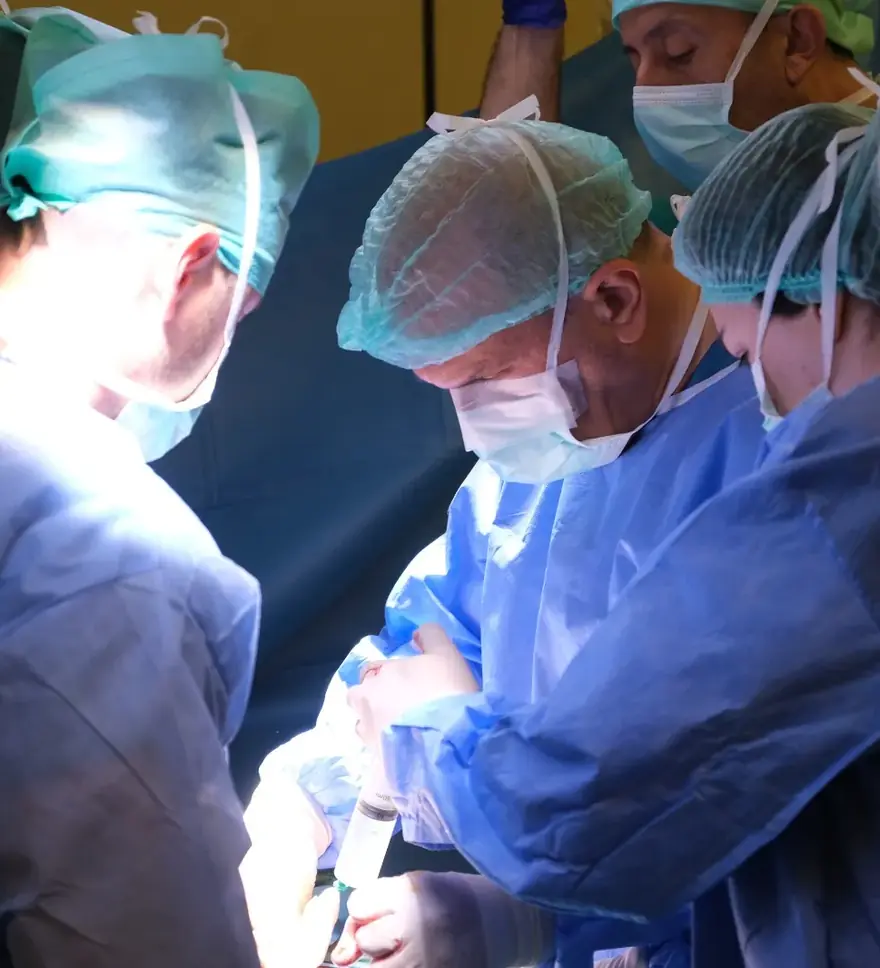
What is revision surgery?
A penile implant is designed to last many years, but some men need a further operation at some point. Revision surgery covers any operation on an existing implant: replacing a worn part, exchanging the whole device, correcting its position or, when necessary, removing it.
Many men who contact us for revision had their first implant elsewhere. We can review your records and imaging online before you decide to travel.
When is revision needed?
Mechanical failure
Inflatable implants have cylinders, a pump, a reservoir and tubing. Over time, a component can leak or stop working, so the implant no longer inflates or deflates properly. This is the most common reason for revision. The surgeon may replace only the failed part or the whole device, depending on its age and condition.
Infection
Infection is the most serious complication. Signs include pain that gets worse rather than better, redness, swelling, fever, discharge from the wound, or a pump that becomes fixed to the skin. An infected implant rarely clears with antibiotics alone and usually needs surgery.
Erosion
Occasionally part of the implant wears through the surrounding tissue, into the urethra or towards the skin of the penis or scrotum. Erosion often goes together with infection and needs prompt treatment.
Position and shape problems
Some men have cylinders that are too short or too long, a glans that droops over the tip of the implant, a curve that remains after surgery, or a pump or reservoir that has moved. These can often be corrected surgically.
Dissatisfaction
A small number of men are unhappy with how the implant looks, feels or works, even when nothing is technically wrong. A careful discussion comes first; sometimes a different device, size or type can help, and sometimes it cannot. Revision does not usually restore length that has already been lost.
How revision is carried out
Every revision is planned individually after examination and, where helpful, imaging. The operation is usually done through the scar of the previous surgery. Broadly, the options are:
- Component replacement: exchanging a single failed part, such as the pump or reservoir.
- Full device exchange: removing the old implant and placing a new one in the same operation. The capsule that has formed around the old device may need to be opened or partly removed.
- Repositioning or reconstruction: correcting the position of a cylinder, pump or reservoir, or supporting the tissues around it.
- Removal: taking out the device, sometimes with a new implant placed later once the tissues have recovered.
Revision operations generally take longer than a first implant, and a longer hospital stay may be advised. Narrower cylinders may be needed in scarred tissue; several brands make these, as described in our brand comparison.
Infected implants: removal and salvage
When an implant is infected, the standard approach is to remove all of its components. Surgeons then choose between two strategies.
- Removal with delayed replacement: the device is taken out, the infection is treated, and a new implant is considered after the tissues have healed, typically some months later. Scarring during this interval can make the later operation harder and the penis may be shorter.
- Salvage (washout and immediate replacement): in carefully selected cases, the old device is removed, the space is washed thoroughly with a series of antiseptic and antibiotic solutions, and a new implant is placed in the same operation. This can help preserve length, but it is not suitable for every infection, for example when there is widespread infection, erosion into the urethra or the patient is unwell.
Which approach is safest depends on how severe the infection is and on your general health. Your surgeon will explain the options and their limits honestly.
If you have signs of infection now, such as fever, spreading redness, discharge or severe pain, please seek medical care locally without delay. You can also contact us and send your details.
Recovery after revision
Recovery follows a similar pattern to a first operation, but it may take a little longer. Expect up to a few nights in hospital, swelling and soreness for several weeks, and a check-up before you fly home. Your surgeon tells you when you can start using the implant, which is often at around six weeks. See the recovery guide for the general timeline.
Risks of revision surgery
Revision carries higher risks than a first implant. Scar tissue makes the operation more demanding, and the risk of infection is higher than in first-time surgery. Other risks include bleeding or haematoma, erosion, further mechanical problems, loss of penile length, and the possibility that a new implant cannot be placed at the same operation. Results vary from person to person, and your surgeon will discuss your individual risks before you decide.
Planning a revision in Istanbul
Before you travel, send us your previous operation notes, the name and model of your implant if you know it, and a description of your symptoms. Prof. Dr. Ateş Kadıoğlu reviews your case and, where possible, discusses it with you by video call. Because every revision is different, it is priced individually after assessment rather than as a fixed package; see penile implant cost in Turkey for an overview.
For general information about the procedure, read penile implant surgery in Istanbul, or contact our team to start.
Last updated: 28 September 2026. This page is for general information and does not replace a medical consultation. Medical disclaimer.