
Editorial
Written byMen's Health Istanbul Editorial Team
Medical reviewer (awaiting sign-off)Asst. Prof. Dr. Yusuf İlker Çömez
Published
Updated
Medically reviewedNot yet
The short answer
The PSA test measures prostate-specific antigen, a protein made by the prostate, in a blood sample. A raised level can be a sign of prostate cancer, but it is often caused by something else, such as an enlarged prostate, infection or recent ejaculation. A normal result does not rule cancer out either. PSA screening has been shown to reduce deaths from prostate cancer, but it also finds slow-growing cancers that would never have caused harm. Whether to be tested is a personal decision to make with a doctor who takes your age and family history into account.
Key takeaways
- PSA is a protein made by the prostate. Levels can rise for many reasons, not only cancer.
- Infection, an enlarged prostate and, in some men, recent ejaculation or vigorous cycling may raise PSA temporarily.
- A large European trial found that PSA screening reduced deaths from prostate cancer, but also led to some men being diagnosed and treated for cancers that would never have harmed them.
- Decisions about testing should be made with a doctor, taking into account age, family history and personal preferences.
What is a PSA test?
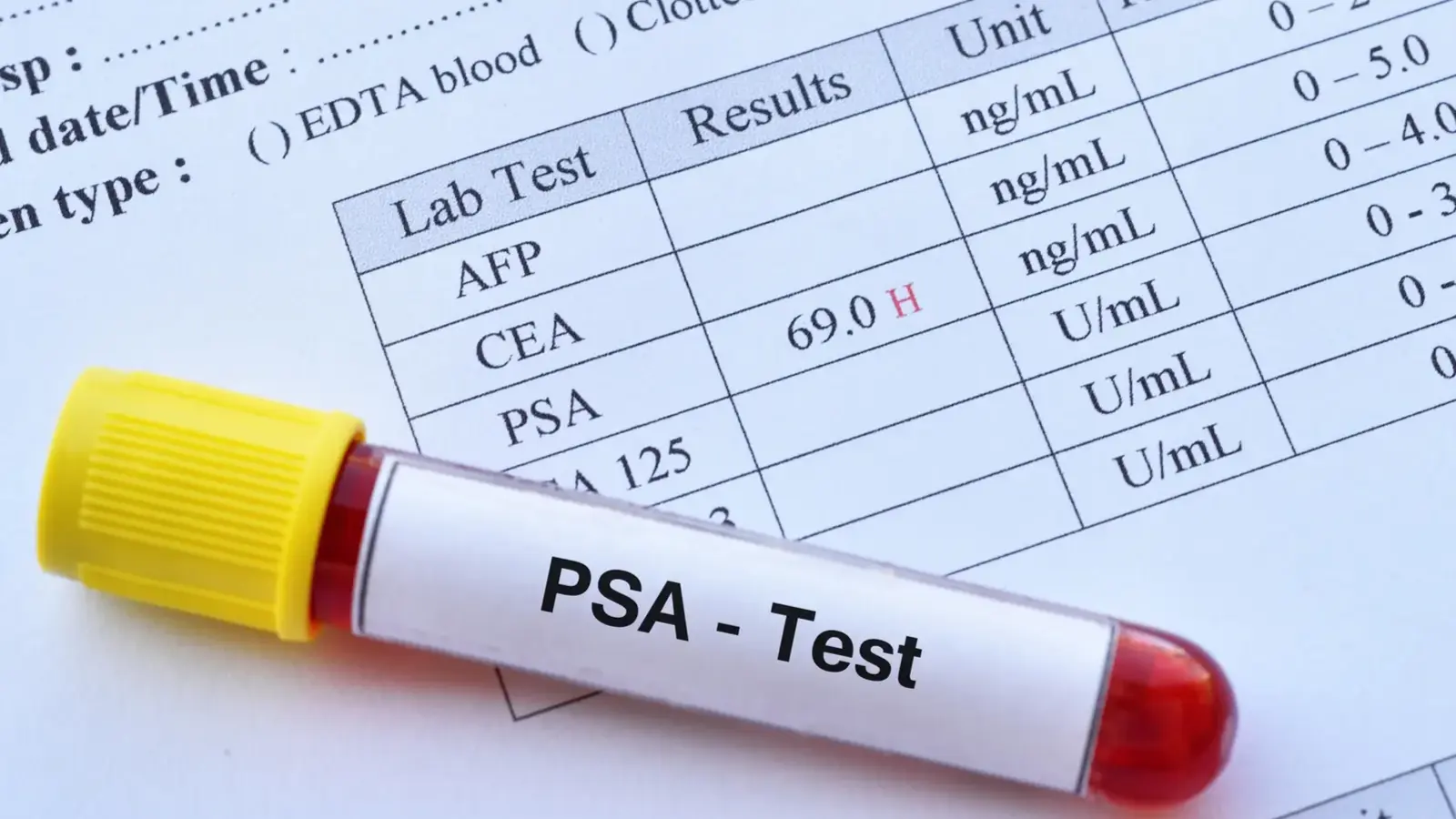
Prostate-specific antigen (PSA) is a protein made by the prostate gland. A small amount normally passes into the blood, where a simple test can measure it. Higher levels can be a sign of prostate cancer, but they are often caused by something else.
What can raise PSA apart from cancer?
- an enlarged prostate (benign prostatic enlargement), which is very common with age;
- infection or inflammation of the prostate or urinary tract;
- recent ejaculation or vigorous exercise such as long-distance cycling;
- some medical procedures on the prostate or bladder;
- prostate cancer.
Some medicines for an enlarged prostate lower PSA, which your doctor needs to know when interpreting the result.
How accurate is the PSA test?
A raised PSA does not mean you have cancer, and a normal PSA does not rule it out. The test can also find slow-growing cancers that might never have caused problems in a man's lifetime. Diagnosing and treating these can lead to side effects, including erectile and urinary problems, without extending life.
The European Randomized Study of Screening for Prostate Cancer, published in the New England Journal of Medicine in 2009, found that PSA screening reduced deaths from prostate cancer. It also highlighted the problem of overdiagnosis. Modern pathways try to keep the benefit while reducing the harms, for example by using MRI scans before deciding on a biopsy.
What should I ask before a PSA test?
- Given my age and family history, what are the likely benefits and harms of testing?
- Is there anything I should avoid before the test, such as ejaculation or cycling?
- If my result is raised, what happens next?
Which prostate symptoms need a doctor?
Testing a man without symptoms is a choice. Symptoms such as blood in the urine or semen, difficulty passing urine or new bone pain are not a choice: they need to be checked by a doctor promptly.
Questions men also ask
Should I avoid sex before a PSA test?
Recent ejaculation may raise PSA temporarily in some men, so doctors often suggest avoiding it for a short time beforehand. Ask your doctor what they recommend.
Does a raised PSA mean I need a biopsy?
Not automatically. The test is often repeated, and modern pathways commonly use an MRI scan before deciding whether a biopsy is needed.
Sources & further reading
- Schröder FH, Hugosson J, Roobol MJ, et al. Screening and prostate-cancer mortality in a randomized European study. N Engl J Med. 2009;360(13):1320–1328. View source (opens in a new tab)
- European Association of Urology. EAU Guidelines on Prostate Cancer. View source (opens in a new tab)
Concerned about something you've read?
Ask one of our specialists privately. There is no obligation, and no question is too awkward.
This article is general health information. It does not replace an individual medical consultation, examination or diagnosis. Read our editorial policy and medical review policy.