
Editorial
Written byMen's Health Istanbul Editorial Team
Medical reviewer (awaiting sign-off)Asst. Prof. Dr. Yusuf İlker Çömez
Published
Updated
Medically reviewedNot yet
The short answer
An enlarged prostate usually does not hurt. Men notice it through changes in urination: a weaker or slower stream, waiting before the flow starts, stopping and starting, dribbling at the end, and a feeling that the bladder has not fully emptied. Many also need to go more often, feel a sudden urge that is hard to hold, or wake at night to pass urine. Symptoms tend to creep up slowly over years. They are common with age and treatable, but similar symptoms can have other causes, so a check with a doctor is worthwhile.
Key takeaways
- An enlarged prostate is felt mainly as changes in urination, not as pain.
- Typical signs are a weak stream, hesitancy, dribbling, frequency, urgency and waking at night to pass urine.
- The size of the prostate does not reliably predict how bad the symptoms are.
- Being unable to pass urine, blood in the urine, fever or pain need prompt medical attention.
What is an enlarged prostate?
The prostate is a walnut-sized gland that sits below the bladder and wraps around the urethra, the tube that carries urine out of the body. In many men it slowly grows from middle age onwards. Doctors call this benign prostatic enlargement or benign prostatic hyperplasia (BPH). "Benign" means it is not cancer.
Because the gland surrounds the urethra, growth can narrow the channel and make the bladder work harder. Over time the bladder muscle can also become more irritable. Together these explain most of the symptoms.
What are the first signs of an enlarged prostate?
Urologists group the symptoms into two sets. The first relate to emptying the bladder:
- a weaker or slower stream than before;
- waiting at the toilet before anything starts (hesitancy);
- a stream that stops and starts;
- straining to pass urine;
- dribbling at the end, sometimes after you think you have finished;
- a feeling that the bladder is still not empty.
The second relate to storing urine:
- needing to go more often during the day;
- a sudden, strong urge that is hard to put off (urgency), occasionally with leaking;
- waking at night to pass urine (nocturia).
Most men notice the changes gradually. It is easy to adapt without realising: planning routes around toilets, cutting down on drinks, or sitting at the end of the row in the cinema.
Does an enlarged prostate hurt?
Usually not. An enlarged prostate is mostly an inconvenience rather than a painful condition. Burning, pain in the lower abdomen or between the legs, or pain on ejaculation suggest something else, such as infection or inflammation, and should be checked.
Does a bigger prostate mean worse symptoms?
Not necessarily. Some men with a large gland have few problems, while others with modest enlargement have troublesome symptoms. What matters most is how much the symptoms bother you and whether there are any complications. That is why guidelines put so much weight on how you feel, not just on measurements.
Could it be something else?
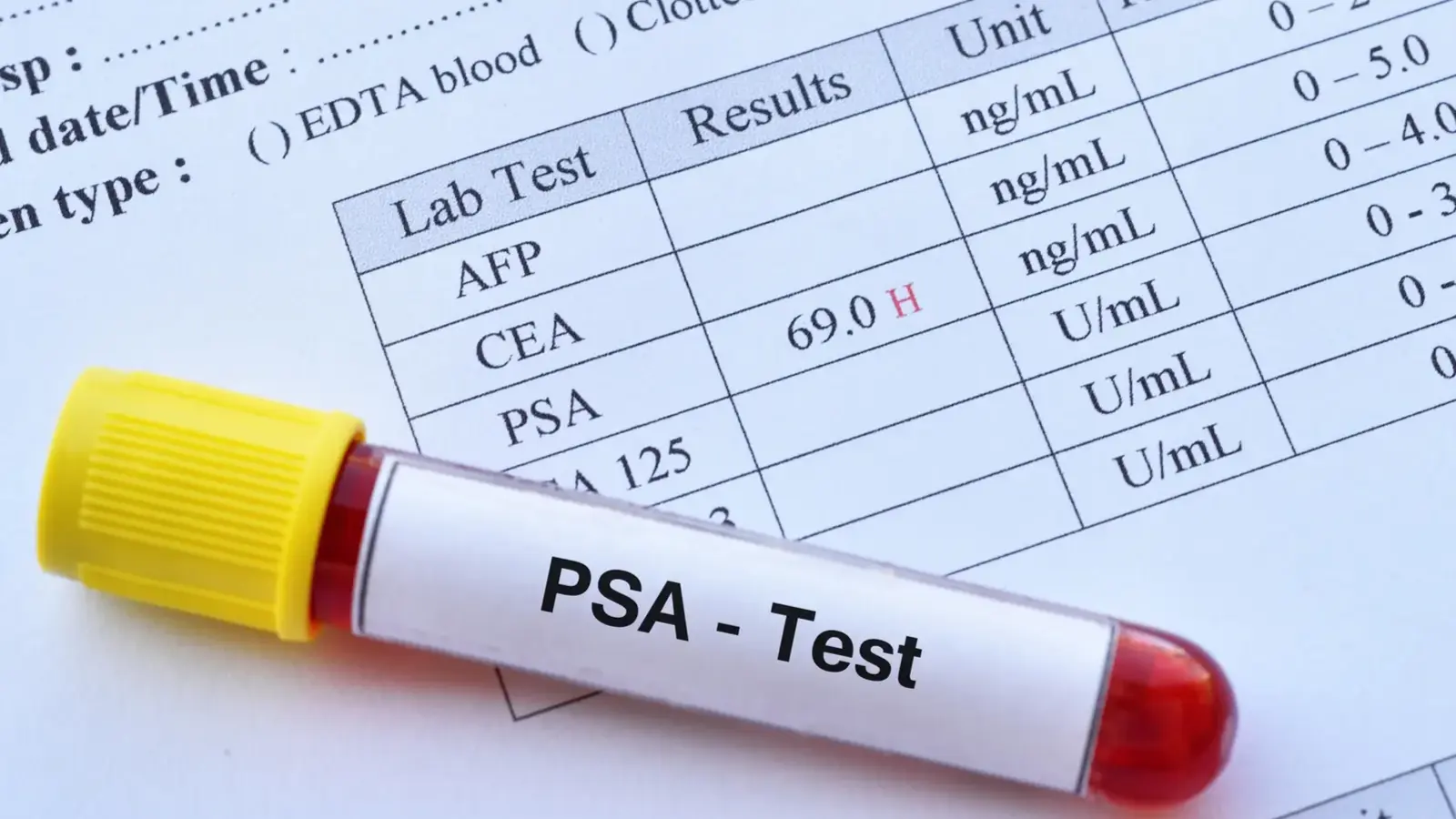
Yes. The same symptoms can come from an overactive bladder, a narrowing of the urethra, infection, diabetes, some medicines, drinking a lot of fluid, caffeine or alcohol in the evening, and, less often, nerve problems or prostate cancer. Early prostate cancer often causes no urinary symptoms at all. Our explainer on the PSA test covers what that blood test can and cannot tell you.
How is an enlarged prostate checked?
A doctor will usually ask you to complete a short symptom questionnaire, test a urine sample and examine the prostate through the back passage, which takes less than a minute. They may also suggest a bladder diary, a urine flow test, an ultrasound scan to see how much urine is left after you go, and a conversation about PSA.
Treatment depends on how bothersome the symptoms are. Options range from simple changes to drinking habits and a watchful approach, to medicines that relax or shrink the prostate, to procedures and surgery when needed. Your doctor decides with you which fits.
When to see a doctor
Book a routine appointment if urinary symptoms are bothering you or waking you at night. Seek help urgently if you cannot pass urine at all, if you see blood in your urine, or if you have fever, shivering or pain with urinary symptoms.
Questions men also ask
Does an enlarged prostate lead to prostate cancer?
No. Benign enlargement and prostate cancer are different conditions, although they can exist at the same time. That is one reason a doctor may discuss a PSA test when assessing urinary symptoms.
Can an enlarged prostate affect sex?
The condition itself is not a direct cause of erectile problems, but both become more common with age. Some medicines and operations for an enlarged prostate can affect ejaculation, which is worth discussing before treatment.
Is it normal to get up at night to urinate?
Waking once occasionally is common. Regularly waking more than once a night is worth mentioning to a doctor, because it can have several causes, including the prostate, the bladder, drinking late or conditions such as sleep apnoea.
Sources & further reading
- EAU EAU Guidelines on Management of Non-neurogenic Male Lower Urinary Tract Symptoms (LUTS) (opens in a new tab) (2024) European Association of Urology
- Journal of Urology Management of Lower Urinary Tract Symptoms Attributed to Benign Prostatic Hyperplasia: AUA Guideline Part I (opens in a new tab) (2021) Lerner LB, et al.
Concerned about something you've read?
Ask one of our specialists privately. There is no obligation, and no question is too awkward.
This article is general health information. It does not replace an individual medical consultation, examination or diagnosis. Read our editorial policy and medical review policy.